
“More than 95% of user assets are kept offline” sounds reassuring until you realize the single point attackers target first is not cold storage but account access. For US-based traders, the mechanics of OKX verification and sign-in determine which attack surfaces are exposed, which trade-offs you accept between convenience and safety, and how much operational discipline — not promises — actually protects your funds.
This explainer walks through how OKX’s verification (KYC) and sign-in systems are built, why those design choices matter for everyday traders, where they can fail, and what practical behaviors and configurations reduce risk. You’ll leave with a mental model to decide what to tighten, what to accept, and what signals to monitor as the platform and regulatory landscape evolve.
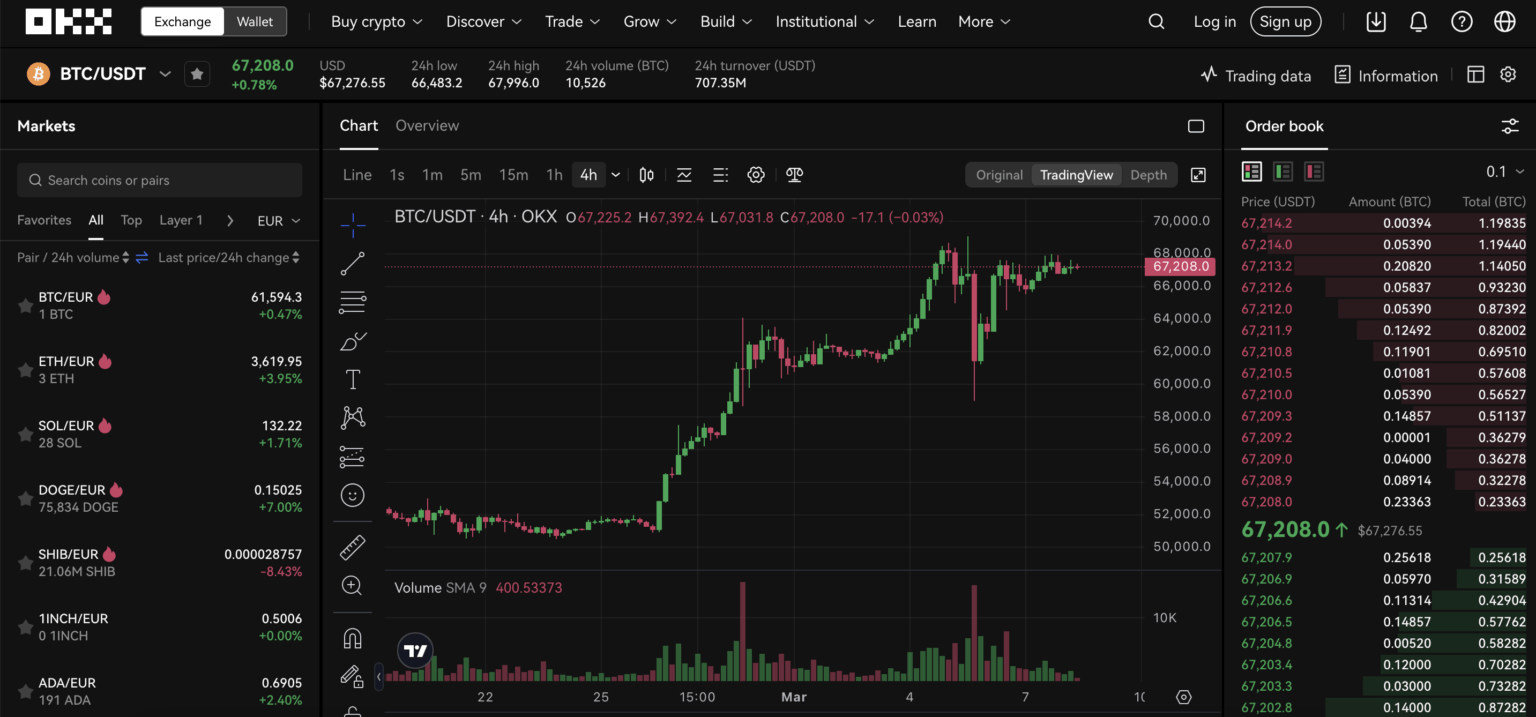
How OKX Verification and Login Mechanisms Work — a mechanism-first breakdown
At the center are two linked systems: identity verification (KYC) and technical access controls (login & 2FA). OKX requires KYC to meet AML obligations: you submit a government-issued ID and complete a facial-recognition liveness check. Mechanistically, KYC ties a wallet-and-account within OKX’s centralized systems to a real-world identity. That linkage enables fiat on-ramps, higher withdrawal limits, and regulatory compliance; it also creates a target for identity theft and state-level data requests.
On the login side, OKX layers military-grade encryption, AI-driven anomaly detection, and mandatory two-factor authentication using SMS, Google Authenticator, or biometrics. For mobile users, biometric unlocking offers convenience and a reduced phishing surface when configured correctly. For browser users, the platform supports hardware-backed methods through WebAuthn-compatible devices and integrates with a browser extension for Web3 flows. Functionally, sign-in is both an authentication process and a gatekeeper that determines whether operations—like withdrawals, margin trading, or linking a non-custodial wallet—can proceed.
Why these choices matter — trade-offs and practical implications
There are three practical trade-offs every trader must evaluate.
1) Convenience vs. attack surface. SMS 2FA is easy but interceptable (SIM swap risks). Authenticator apps are stronger; hardware keys or biometric login on mobile reduce remote-exploit risk further. If you frequently trade across devices, you’ll trade convenience for resilience by using hardware-backed keys.
2) Custody comfort vs. control. OKX combines centralized custody (with >95% in cold wallets and multi-signature withdrawal controls) and a non-custodial Web3 wallet option where you control private keys. Using OKX’s custodial services simplifies staking, margin, and derivatives access, but regulators, exchange outages, or internal errors can temporarily or permanently restrict access. Self-custody avoids counterparty risk but shifts all operational security to you: seed phrase loss is irreversible.
3) Transparency vs. privacy. Proof of Reserves (PoR) provides on-chain verifiability that tokens exist; KYC ties identities to accounts. PoR reduces systemic counterparty risk uncertainty for users, but KYC disclosure creates privacy and surveillance trade-offs familiar to US users who value anonymity for legitimate reasons.
Where it breaks — common failure modes and how to mitigate them
Verification and login are robust in design but fragile in practice because human and peripheral-system failures dominate incidents. Common failure modes include phishing pages that mimic the sign-in flow, leaked KYC documents via reused email passwords, SIM swaps that defeat SMS 2FA, and social-engineering attacks on customer support to change account controls.
Mitigations that materially lower risk:
– Use an authenticator app or hardware security key for 2FA; reserve SMS only as a fallback. – Separate your exchange email from other high-use accounts and enable strong, unique passwords with a password manager. – Enable AI-driven anomaly alerts where possible and subscribe to OKX account activity notifications. – Treat your KYC documents as sensitive: consider watermarking copies you store offline and use different channels to transmit them when possible. – For large holdings, split between custodial (for active trading and staking) and self-custodial cold storage (for long-term holdings), and test recovery processes regularly.
Sign-in nuances for the US trader: legal and operational context
US-based traders should be explicit about two points. First, KYC is not optional for many services and is integral to fiat operations; delaying or rejecting KYC will limit fiat deposits, higher withdrawal tiers, and regulated-product access. Second, regulators can and do issue subpoenas; a centralized ledger that links your identity to funds can be disclosed without your consent under legal processes. That is a structural limitation of CEX usage in a regulated jurisdiction, not a bug in OKX specifically.
If your strategy relies on privacy-sensitive trading, weigh whether decentralized exchanges, relayers, or privacy tools (used lawfully) better match your risk tolerance. For traders focused on derivatives, remember that high leverage (up to 125x on some products) amplifies not just returns but operational errors, including those caused by compromised credentials.
Practical walkthrough: tightening an OKX sign-in for trading
Step-by-step: register, complete KYC (photo ID + liveness check), enable a non-SMS 2FA, connect hardware key if available, verify email and withdrawal whitelist, and enable withdrawal confirmations and anti-phishing codes. When you link a Web3 wallet for DEX aggregation or NFT activity, prefer hardware wallets for signing large or unfamiliar transactions. A small habit with big effect: once a week review recent session logs for new IPs or devices—AI detection helps, but human review catches subtle patterns.
If you need to re-enter the platform or are troubleshooting a rejected KYC, follow the official sign-in flow carefully; attackers often exploit users during recovery processes. For direct help or to re-start the login flow through an official landing page, see this resource for practical entry: okx login.
Decision heuristics — a short checklist traders can reuse
– Holding horizon: short-term traders can accept more custodial exposure; long-term holders should split funds and rely on self-custody for the majority. – Transaction size: increase authentication strength (hardware key) for accounts with higher withdrawal limits. – Feature need: if you need margin, futures, or staking inside OKX, expect mandatory KYC; if you want pure swapping with less identity friction, examine DEX aggregator routes. – Recovery readiness: practice seed phrase and account recovery under non-stress conditions.
What to watch next — conditional signals and implications
Monitor three signals that would change the calculus for US traders. First, regulatory shifts that raise KYC requirements or reporting thresholds could make non-custodial options more attractive. Second, improvements in account-level cryptographic authentication (wider WebAuthn adoption) will lower phishing risk and may shift industry practice away from SMS. Third, deployable security incidents at major exchanges will reveal operational weaknesses; each incident increases the premium of proof-of-reserves and on-chain transparency measures.
None of these are certainties. They are conditional scenarios: stronger regulation would push more activity into compliant exchanges for fiat rails; better authentication standards would make account compromise less common; and security incidents will alter user behavior incrementally, not instantly.
FAQ
Q: How long does OKX KYC verification take for US users?
A: Timing varies by volume and the completeness of your submission. Mechanistically, automated ID and liveness checks can be fast (minutes to hours) but manual reviews occur for edge cases. If automated checks fail, be prepared for longer delays while identity documents are reviewed. The practical takeaway: submit clear, unambiguous ID photos and use stable network conditions to reduce false rejections.
Q: Is biometric login safer than Google Authenticator?
A: Biometric login is safer against remote phishing if the biometric data is device-local and uses hardware-backed secure enclaves. Google Authenticator is stronger than SMS because it avoids the SIM-swap vector. The strongest setup combines hardware-backed biometrics or a security key with an authenticator app as a fallback; avoid SMS as the primary 2FA whenever possible.
Q: If my OKX account is verified, can I lose access to my funds?
A: Yes—verification does not guarantee uninterrupted access. Risks include compromised credentials, customer-support social engineering, regulatory freezes, or exchange operational failures. OKX mitigates systemic custodial risk through cold storage and Proof of Reserves, but individual access can still be interrupted if credentials or device security are breached.
Q: Should I use OKX’s non-custodial Web3 wallet or the exchange wallet?
A: Use both with a purpose: custodial accounts for active trading, staking, and fiat on/off ramps; non-custodial for long-term holdings where you control keys. The trade-off is operational: self-custody requires disciplined backup and recovery processes; custodial solutions require trust in the platform’s security and compliance practices.
Closing thought: security in crypto is never a single setting you enable and forget. It’s a configuration space of choices — authentication strength, custody model, verification behavior, and personal operational habits — that together determine how safe your positions actually are. For US traders using OKX, focus on the weakest link in your personal chain and strengthen it first: often that’s account recovery and 2FA, not cold storage guarantees.