
Surprising fact: a modern crypto account is often two systems in one — a centralized ledger you access through an exchange and a separate self-custodial identity that controls on‑chain assets — and OKX explicitly tries to bridge both. For a US-based trader deciding when and how to log in and use OKX, that bridging is useful but introduces trade-offs you should understand before you click “Sign in.”
This piece is a practical, mechanism-first guide to the OKX login experience and the platform’s position in today’s market. I’ll explain how the login and account model works, why OKX combines custodial and non-custodial services, where that design helps and where it creates vulnerability, and what specific signals and safeguards a US trader should watch. The treatment emphasizes actionable choices — which authentication to use, when to move assets off exchange, and how to reason about the balance between convenience and control.
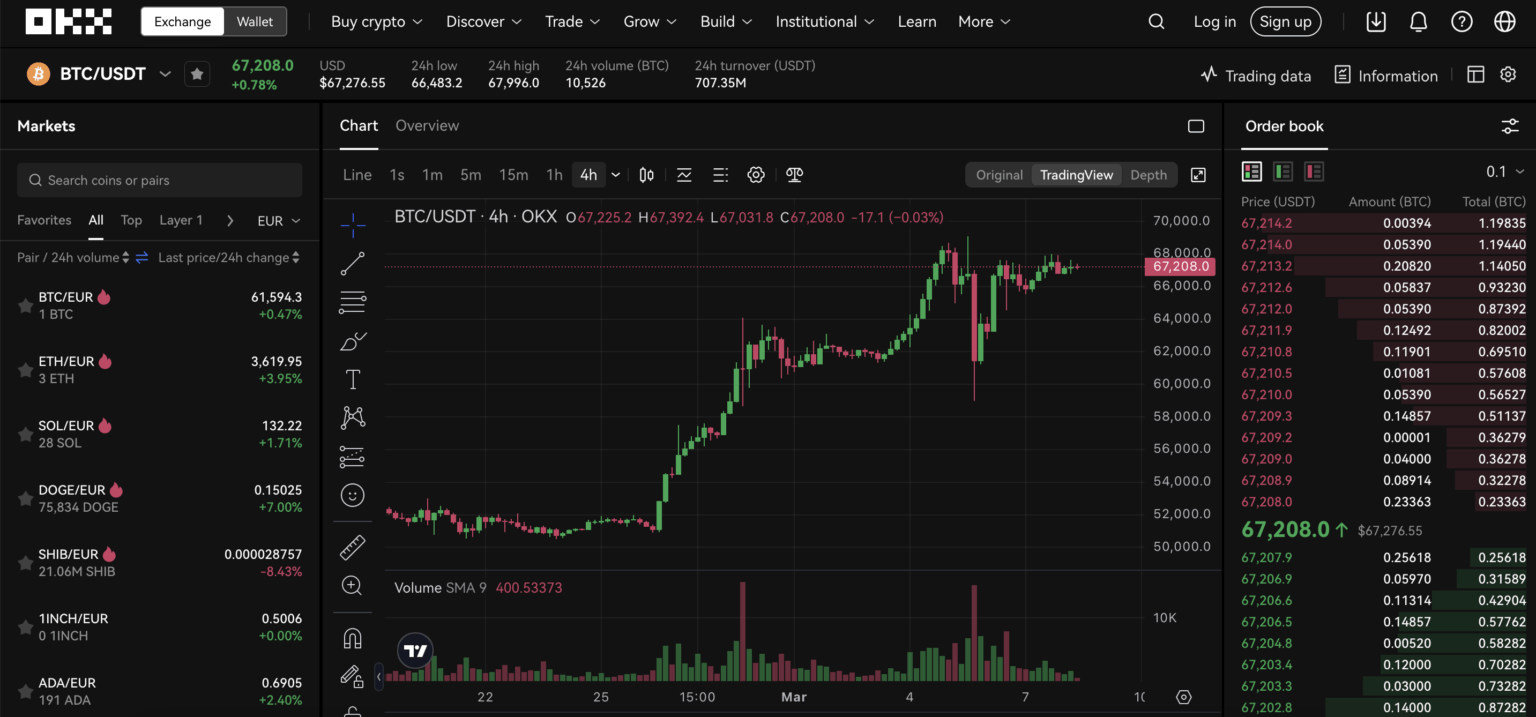
How OKX’s login model works: layers and mechanisms
At the core, OKX presents two layers to the user: a centralized exchange account (CEX) that holds custodial balances and a non‑custodial Web3 wallet where the user holds private keys. Logging into the exchange first authenticates you to the CEX layer: username/email plus password, mandatory KYC for US users, and a second factor. OKX enforces Two‑Factor Authentication (2FA) — SMS, Google Authenticator, or biometrics — and adds AI-driven threat detection to flag unusual login attempts. Those are the mechanisms that stop many automated hacks, but they are not bulletproof against social engineering or SIM swap attacks.
If you choose to use OKX’s Web3 wallet, that wallet runs a different trust model: you control a seed phrase (non‑custodial) and can connect to DApps, the NFT marketplace, and cross-chain bridges. The platform also supports hardware wallets like Ledger and Trezor. In practice this means a single interface can be both a gated CEX session and an on‑chain identity; the login step is therefore the point where centralized protections end and decentralized responsibility begins.
Why this hybrid matters — and where it breaks down
Advantages are straightforward: convenience and feature integration. From one account you can spot trade, open futures, stake tokens, mint NFTs, and sign out to the Web3 wallet for DeFi activity. OKX also publishes Proof of Reserves (PoR) and keeps over 95% of custodial assets in multi‑signature cold storage, which reduces institutional counterparty risk compared with smaller exchanges.
But the hybrid model creates two primary limits. First, custody discontinuities: assets you hold on the CEX are protected by cold wallets and PoR but require trusting OKX’s operational integrity. Assets in the non‑custodial wallet grant you more control but expose you to irreversible losses if you lose your seed phrase or sign a malicious contract. Second, attack surface: a single UI that unifies CEX and wallet features makes phishing and click‑jacking more valuable to attackers because one successful trick can compromise both custodial balances (through social engineering) and private keys (through deceptive signing).
For US traders this has regulatory consequences, too — KYC and AML checks are mandatory, and providing identity creates different remediation pathways (e.g., support requests) than self‑custodial losses, which are typically irreversible. That influences a rational allocation: keep capital you need for active trading on the exchange under strong 2FA and limited leverage; keep long-term holdings that you want absolute control over in a hardware-backed, non‑custodial setup.
Logging in safely: a decision-useful checklist
There’s no single “best” practice; there are trade-offs. Below is a prioritized checklist you can use when logging into OKX from the US.
1) Use hardware-backed 2FA where possible. Google Authenticator or hardware security keys reduce SIM‑swap risk. Avoid SMS as the sole 2FA for large balances.
2) Separate roles by purpose. Keep an operational trading balance on the CEX that you are comfortable losing temporarily during downtime, and place long-term holdings in a self‑custodial wallet integrated with Ledger/Trezor.
3) Verify URLs and sign-in endpoints. Phishing is the most common external attack vector. When confident, access OKX via bookmarked pages or the official mobile app. For quick login help and official entry points, see OKX’s own access path here: okx.
4) Link accounts to email addresses and phones that are protected by strong password managers and recovery plans. Consider a dedicated email for exchange activity to reduce blast radius from unrelated account compromises.
5) Monitor on‑chain proofs and balances. Proof of Reserves provides a transparency signal — not a guarantee — but checking it regularly gives you a sense of systemic integrity.
Trading features that change the login calculus
What you intend to do on OKX affects how aggressively you should protect your account. Margin and derivatives products increase the consequences of account compromise: with up to 10x leverage on margin and up to 125x on some futures, a single unauthorized trade can wipe an account rapidly. That raises two practical rules of thumb: limit allowable leverage on accounts used for frequent logins from mobile devices, and segregate derivatives activity into a separate account or sub‑account with stricter withdrawal limits.
The presence of an integrated NFT marketplace and DEX aggregator also matters. Minting NFTs or interacting with DEXs forces you to sign on‑chain transactions. Treat every signature as a potential delegation of authority; read prompts carefully and prefer hardware wallets for any transaction that involves moving meaningful funds or granting approvals.
Where OKX stands in the broader ecosystem and what to watch next
OKX sits at an intersection: it is a full-featured CEX with institutional-grade custody practices, and it is expanding Web3 tooling that equals many standalone wallets. The immediate implication is strategic: regulatory pressure in the US will continue to shape identity and product availability, while demand for seamless cross‑chain experiences will push OKX to refine wallet UX and security posture.
Signals to monitor in the coming months include: changes to KYC/AML flows that affect US users, any announced modifications to PoR methodology (which would change transparency calculus), and updates to wallet‑to‑CEX segregation that reduce phishing risk. If OKX tightens hardware‑only approvals or introduces account‑level withdrawal whitelists, that would materially lower systemic risk for US traders.
One unresolved question is how exchanges balance on‑platform convenience with the irreversible realities of self‑custody. Mechanisms like account recovery for non‑custodial wallets remain a hard problem; until there’s a widely accepted standard, traders will need to accept a trade‑off between convenience and finality.
Decision heuristics: a quick mental model
Use this three‑node mental model when deciding how to log in and where to hold assets: Liquidity (how soon you need funds), Control (how much private‑key risk you accept), and Exposure (leverage and derivative usage). If Liquidity is high and Exposure (leverage) is low, custodial balances with strong 2FA make sense. If Control is paramount and Exposure involves only spot holding, use a self‑custodial hardware wallet. If Exposure is high (derivatives), segregate accounts and harden authentication.
FAQ
Is OKX safe to log into from the US?
Relative to many smaller exchanges, OKX has strong institutional controls (cold storage, PoR, AI threat detection). That reduces systemic risk, but “safe” is conditional: user practice matters. Use non‑SMS 2FA, hardware wallets for large holdings, and be vigilant about phishing. Regulatory and operational risks cannot be eliminated completely.
Should I keep all my crypto on OKX after logging in?
No single place fits all needs. Keep funds you trade frequently and need for margin on the exchange with strict 2FA and withdrawal limits. Move long‑term savings to a non‑custodial wallet with hardware backup. Treat any on‑exchange holdings as contingent on the exchange’s operational security and regulatory position.
What 2FA method is best for OKX login?
Hardware security keys and authenticator apps (like Google Authenticator) are stronger than SMS. Biometrics are convenient on mobile but should be combined with a robust device passcode and, for large balances, hardware 2FA where possible.
Does OKX support on‑chain proofing of assets?
Yes, OKX provides Proof of Reserves that you can use as a transparency check. PoR increases confidence but does not replace personal security hygiene — PoR says the exchange holds assets, not that individual accounts cannot be compromised.
Practical takeaway: treat OKX as a powerful, integrated platform that can simplify work but cannot absolve you of basic cryptographic hygiene. Log in securely, think in terms of liquidity-control-exposure, and use hardware backups and account segregation when stakes are high. Those habits are the best defense against both fast markets and slow human mistakes.